Updated August 2026 · Based on current Seoul Metropolitan Government and Korea Tourism Organization information
Planning to use buses and subways during your Seoul trip? The Seoul Climate Card remains a useful option for short-term visitors in 2026, even as Seoul transitions away from its longer-term 30-day Climate Card.
The key point for tourists is simple:
The end of the 30-day Climate Card does not mean the short-term tourist passes are disappearing.
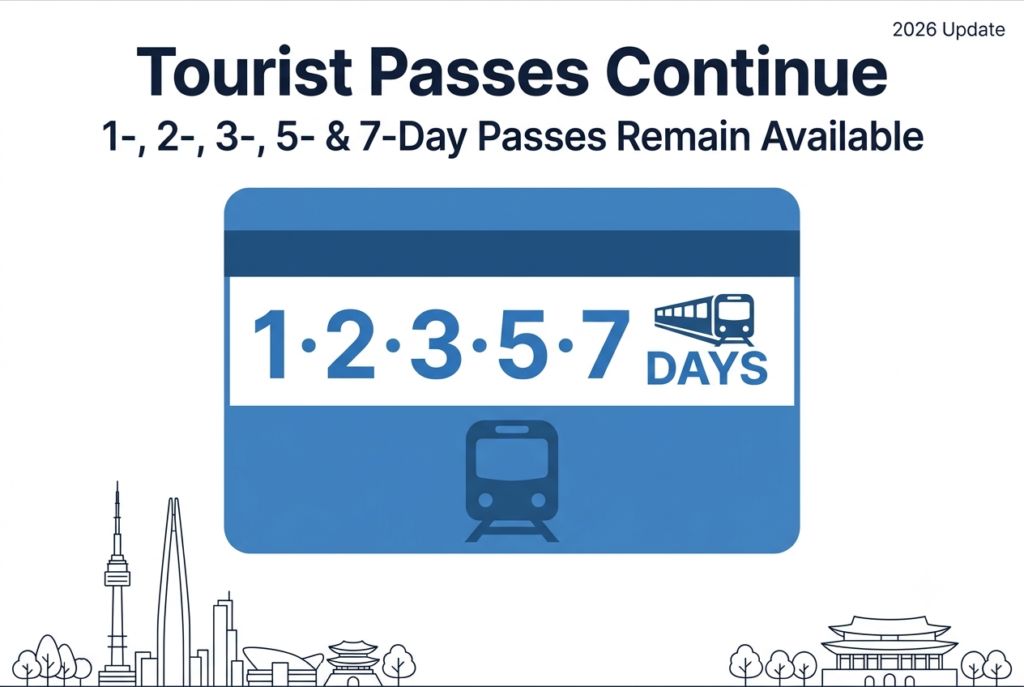
Current official guidance says existing Climate Cards can continue to be loaded with 1-, 2-, 3-, 5-, and 7-day short-term passes.
Seoul Climate Card 2026: Quick Answer
- Tourist short-term passes: Still available
- 1-day: ₩5,000
- 2-day: ₩8,000
- 3-day: ₩10,000
- 5-day: ₩15,000
- 7-day: ₩20,000
- Physical card: ₩3,000
- Activation: Starts on the calendar day you recharge it
- Advance activation: Not available for short-term passes
- International cards: Accepted at supported upgraded vending machines
- Airport buses: Not included
- Sinbundang Line and GTX: Not included
Quick tip: A short-term Climate Card makes the most sense if you expect to use covered buses and subways frequently while staying mainly in Seoul. If you plan to travel outside the coverage area often, a regular T-money card may be more flexible.
Check Official Climate Card Information →
https://english.seoul.go.kr/policy/transportation/climate-card/
What Is the Seoul Climate Card?
The Climate Card is an unlimited-use transportation pass for covered public transportation during its validity period.
For international tourists and other short-term visitors, the most relevant options are:
- 1-day pass
- 2-day pass
- 3-day pass
- 5-day pass
- 7-day pass
These passes can be convenient if you plan to ride Seoul buses and subways frequently.
However, unlimited does not mean every train and bus in the Seoul metropolitan area is covered.
The exact service area matters.
What Is Changing in 2026?
Seoul has announced the discontinuation of the prepaid 30-day Climate Card.
The Seoul Metropolitan Government currently states that the 30-day prepaid Climate Card can be recharged until August 31, 2026.
Existing Climate Cards can still be recharged with short-term 1-, 2-, 3-, 5-, and 7-day passes.
VISITKOREA currently states that from October 1, 2026, only the short-term Climate Card passes will remain available, while the 30-day products will be discontinued.
Because Seoul is in a transition period and official pages may be updated on different schedules, travelers visiting in late September or after October 2026 should check the latest official Climate Card page before purchasing.
This guide focuses only on the short-term passes relevant to visitors.
Seoul Climate Card Short-Term Pass Prices
Current official short-term prices are:
| Pass | Price |
|---|---|
| 1 day | ₩5,000 |
| 2 days | ₩8,000 |
| 3 days | ₩10,000 |
| 5 days | ₩15,000 |
| 7 days | ₩20,000 |
A physical Climate Card costs an additional ₩3,000.
For example, a first-time traveler buying a physical card and loading a 3-day pass would pay:
₩3,000 card + ₩10,000 pass = ₩13,000
The physical card can be reused.
Important: The Pass Starts on the Day You Charge It
This is one of the easiest mistakes for tourists to make.
A short-term Climate Card begins on the calendar day you recharge it.
You cannot load a short-term pass in advance and choose a future activation date.
For example, if you load a 1-day pass late in the evening, it is still treated as that day’s pass and remains valid only through the final covered bus or subway service of that day.
Recharge the pass on the day you actually want to start using it.
This is especially important if you arrive in Seoul late at night.
Where Can You Use the Climate Card?
The current Climate Card network covers eligible Seoul subway services and Seoul-licensed buses.
Important exclusions include:
- Sinbundang Line
- GTX
- intercity buses
- airport buses
- non-Seoul-licensed buses
- subway travel outside the designated service range unless a specific exception applies
Short-term passes currently do not include Ttareungi (Seoul Bike) or Hangang Bus.
If your itinerary includes the outskirts of Seoul, Gyeonggi Province, or Incheon, check the official service range before traveling.
Bus and Subway Coverage Work Differently
The rules for buses and subways are not identical.
For buses, the Climate Card can be used on Seoul-licensed buses even when boarding or getting off outside Seoul.
Subway coverage is stricter.
If you board within the Climate Card service range but get off at a station outside the permitted range, the Climate Card may not cover the full journey and an additional fare may be collected.
Do not assume every station on a subway line extending outside Seoul is included.
Can You Use the Climate Card for Incheon Airport?
Still preparing for your arrival in Korea? Read our Korea e-Arrival Card 2026 guide before your flight.
It depends on the direction of travel.
Under the current rules, the regular Climate Card AREX service area covers Seoul Station to Gimpo International Airport Station.
There is also a specific airport exception.
If you board within the eligible Climate Card service area, you can currently get off at Incheon International Airport Terminal 1 or Terminal 2.
However, you cannot board AREX at Incheon Airport Terminal 1 or Terminal 2 using the Climate Card under the current rules.
In practical terms:
Seoul → Incheon Airport may work under the current exit exception.
Incheon Airport → Seoul cannot be started with the Climate Card at T1 or T2.
Airport buses are not included.
Because transportation coverage can change, verify the latest official service-area information before using the card for an airport trip.
Where Can Tourists Buy a Climate Card?
Physical Climate Cards are available through locations including:
- supported transit-card vending machines inside Seoul subway stations
- participating convenience stores near certain subway stations
The Seoul Metropolitan Government currently lists physical cards at new vending machines across Seoul Metro Lines 1–8, with additional participating convenience stores near stations on Line 9, the Ui-Sinseol Line, and the Sillim Line.
Availability can vary by location, so a supported station vending machine is often the simplest option for international visitors.
Can Foreign Tourists Pay With an International Credit Card?
Yes, at supported upgraded machines.
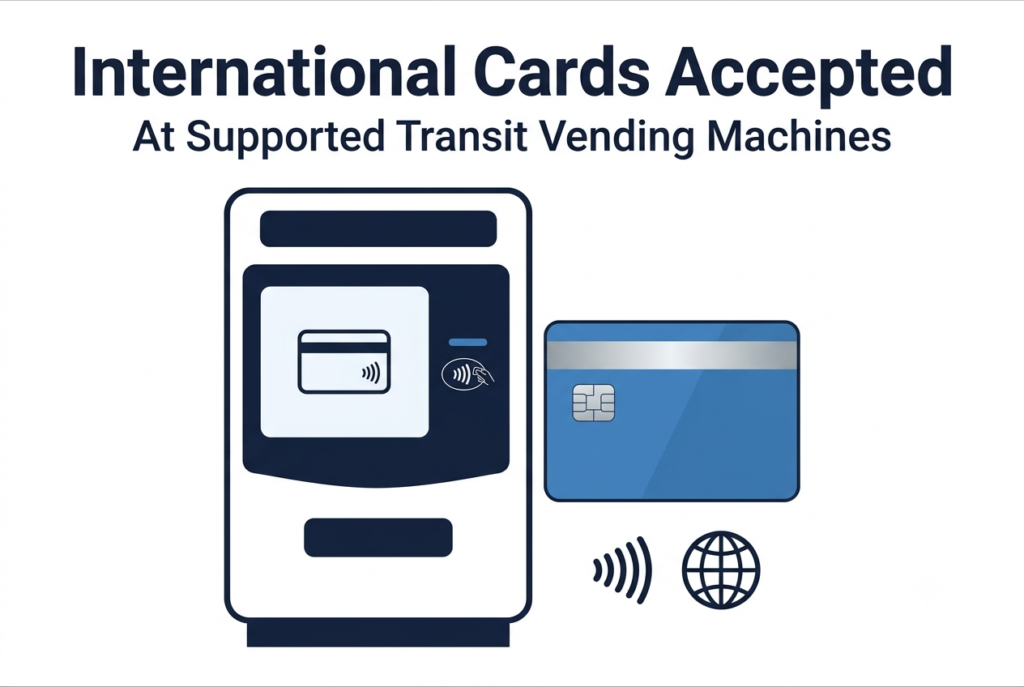
Seoul expanded international payment support in 2026, allowing foreign visitors to purchase Climate Cards and recharge short-term passes with internationally issued credit and debit cards at designated new transit-card vending machines.
The official rollout includes cards such as Visa and Mastercard.
Seoul’s March 2026 announcement states that the upgraded system covers 440 vending machines at 273 subway stations on Lines 1–8.
International credit and debit card transactions may include an additional service fee. The same Seoul announcement cites an average fee of approximately 3.7%.
Payment options can vary by machine and card issuer, so check the payment screen before confirming the transaction.
Physical Card or Mobile Climate Card?
For many international tourists, the physical Climate Card is the simplest option.
The current mobile Climate Card is available for compatible Android devices, while its payment and setup requirements may be less convenient for short-term overseas visitors.
If you use an iPhone or do not have compatible local payment arrangements, a physical Climate Card is usually the more straightforward choice.
For a typical visitor:
- Buy a physical Climate Card.
- Choose the short-term pass that fits your itinerary.
- Recharge it on the day you want the pass to begin.
- Tap when entering and leaving covered transportation.
How to Use the Climate Card
Tap the card when entering or boarding covered transportation.
Tap it again when leaving or getting off.
Always tap out.
Under the current official rules, failing to tap when getting off twice results in Climate Card use being suspended for 24 hours from the time of your last boarding.
An unlimited pass still requires correct tap-in and tap-out behavior.
Climate Card vs T-money: Which Is Better for Tourists?
Neither card is automatically better for everyone.
Climate Card May Be Better If:
- most of your itinerary is within the covered Seoul network
- you expect frequent subway and bus rides
- you prefer a fixed transportation cost
- you do not want to calculate individual covered fares
T-money May Be Better If:
- you take relatively few rides
- you travel outside the Climate Card service area frequently
- you need transportation not covered by the Climate Card
- you want a general pay-as-you-go transportation card
The Climate Card provides unlimited covered rides during a fixed period.
T-money is primarily pay-as-you-go.
The better choice depends on your actual itinerary.
Is the Climate Card Worth It for a 3-Day Seoul Trip?
It can be.
The 3-day short-term pass costs ₩10,000.
If you need a new physical card, the first-time total is:
₩10,000 pass + ₩3,000 card = ₩13,000
Whether it saves money depends on:
- how many public-transport rides you take
- which subway lines and buses you use
- whether you travel outside the covered network
For travelers using Seoul public transportation many times each day, the convenience can be valuable even if the monetary saving is modest.
Common Tourist Mistakes to Avoid
Charging the Pass Too Early
Short-term passes begin on the calendar day you recharge them.
Do not load the pass before the day you want to start using it.
Assuming Every Seoul-Area Subway Station Is Covered
Coverage is route- and station-specific.
Trips beyond the official service range can require an additional fare.
Assuming Airport Buses Are Included
They are not.
Assuming the Climate Card Works From Incheon Airport
Current rules allow a specific AREX exit exception at Incheon Airport T1 and T2, but you cannot board there using the Climate Card.
Confusing the 30-Day Transition With Tourist Passes
The 30-day product is being discontinued.
The short-term visitor passes continue.
Forgetting to Tap Out
Two missed tap-outs can trigger a 24-hour suspension.
Frequently Asked Questions
Can foreigners buy the Seoul Climate Card?
Yes. Short-term Climate Card passes are available to international tourists and other short-term visitors.
Is the Climate Card being discontinued in 2026?
The 30-day Climate Card is being discontinued, but current official guidance says the short-term 1-, 2-, 3-, 5-, and 7-day passes will continue.
How much is a 3-day Climate Card?
The 3-day short-term pass costs ₩10,000. If you need a new physical Climate Card, add ₩3,000 for the card itself.
Can I buy a Climate Card with a foreign credit card?
Yes, at supported upgraded transit-card vending machines. Internationally issued cards such as Visa and Mastercard are supported as part of Seoul’s international-payment rollout.
Is there a fee for using an international card?
Yes, a service fee may apply. Seoul’s March 2026 announcement states that international credit and debit card transactions at supported machines carry an average fee of approximately 3.7%.
Check the payment screen before confirming your transaction.
Can I use the Climate Card on AREX?
Partly.
The regular Climate Card AREX service area currently covers Seoul Station to Gimpo International Airport Station.
Passengers who board within the eligible service area can currently get off at Incheon Airport Terminal 1 or Terminal 2.
However, you cannot board AREX at T1 or T2 using the Climate Card under the current rules.
Does the Climate Card cover airport buses?
No. Airport buses are not included.
Does the Climate Card cover Sinbundang Line?
No. The Sinbundang Line is not covered.
Does the Climate Card cover GTX?
No. GTX services are not included.
Does a short-term Climate Card include Seoul Bike?
No. Current official short-term pass information states that Ttareungi (Seoul Bike) and Hangang Bus are not included.
Can I activate a short-term pass in advance?
No. The validity period begins on the calendar day you recharge the pass, so load it on the day you want to start using it.
Before You Buy
For most short-term visitors, the choice comes down to how and where you plan to travel.
Choose the Climate Card if you expect frequent covered public-transport rides mainly around Seoul.
Choose T-money if you want greater flexibility or expect significant travel outside the Climate Card network.
If paid attractions matter more than unlimited transit, compare the options in our Discover Seoul Pass 2026 guide.
If you also want a Korean prepaid payment card with currency exchange and a built-in T-money function, see our WOWPASS Korea 2026 guide.
Planning several paid attractions in Seoul too? See our Discover Seoul Pass 2026 guide to compare whether a sightseeing pass makes sense alongside your transit setup.
Your hotel location also affects how much public transport you are likely to use. See our Where to Stay in Seoul 2026 guide before deciding whether your Seoul itinerary is likely to be transit-heavy enough to justify a transport pass.
If you are traveling during or after the September–October 2026 transition, check the latest official Climate Card rules shortly before purchasing.
The key point for tourists is simple:
The end of the 30-day Climate Card does not mean the short-term visitor passes are disappearing.
Official Sources & References
Seoul Metropolitan Government — Climate Card
Primary official source for the 30-day Climate Card discontinuation notice, short-term pass continuation, prices, physical card cost, activation timing, coverage, AREX airport rules, purchase methods, short-term exclusions, and tap-out rules.
Seoul Metropolitan Government — International Card Payment Expansion
Official March 2026 announcement covering international credit and debit card payments, supported vending machines, Visa and Mastercard examples, and the average international-card service fee.
Seoul Metropolitan Government — Climate Card Plus Transition
Official background on Seoul’s 2026 transition and confirmation that tourist short-term passes continue.
VISITKOREA — Transportation Cards
Korea Tourism Organization guidance covering short-term Climate Card prices, tourist use, physical card cost, and the October 2026 transition.